A vacuum is defined colloquially as the state encountered in a room at pressures below atmospheric pressure. These pressures can be generated by gases or vapors that are evenly distributed over the room.
The standard definition of vacuum is “the state of a gas at which its pressure in a vessel and therefore its particle density is lower than that of the ambient surrounding atmosphere or in which the pressure of the gas is lower than 300 mbar, i. e. lower than the pressure of the atmosphere on the Earth’s surface.“ [2]
1.1.2 Overview of vacuum
The significance of the 300 mbar specified in the standard becomes apparent when the barometric formula is considered. Atmospheric pressure sinks with increasing altitude due to the decreasing weight of the column of air over a certain area.
-
p_{h}=p_0\cdot\exp\left(-\frac{\rho_0\cdot g\cdot h}{p_0}\right) Formula 1-1: Barometric formula
-
p_h Atmospheric pressure at heighth_ -
p_0 Atmospheric pressure at sea level = 1,013.25 mbar oder 101,325 Pa -
g Acceleration of gravity = 9.81 m s-2 - ρ0 Density of air at sea level at 0 °C = 1.293 kg m-3
If for the purposes of simplification we assume that the density of the air, the acceleration of gravity and atmospheric pressure at sea level are constant, we obtain by summarizing:
-
p_{h}=p_0\cdot\exp\left(-\frac{h}{8.005\mbox{ m}}\right) Formula 1-2: Numerical barometric formula
If
p_h = p_0/2 and the equation is solved for
h_ , the result is the half altitude value
h_{1/2} = 5,548 m. In other words: atmospheric pressure is halved every 5,548 km.
If the height value in the formula is substituted with the height of Mount Everest, we obtain a pressure of 335 mbar or, expressed in the formal SI unit, 33,500 Pa or 335 hPa. This explains the 300 mbar given in the standard as the lowest atmospheric pressure present on the Earth’s surface.
In this book we will give pressures in the SI unit Pa supplemented by the prefix “hecto” in order to correlate the standard-compliant SI unit with the mbar numerical values commonly used in central Europe.
At the cruising altitude of a passenger jet of approximately 10,000 m above the surface of the Earth, atmospheric pressure has already decreased to 290 hPa. Weather balloons rise to a height of up to 30 km where the pressure is 24 hPa. Polar-orbiting weather satellites fly along a polar, sun-synchronous orbit at an altitude of about 800 km. The pressure here has already fallen to approximately 10-6 hPa. The greater the distance from a planet, a sun or a sun system, the lower the pressure becomes. The lowest known pressures are found in interstellar space.
In a range of technical applications, the pressure is not indicated as absolute but as relative to atmospheric pressure. The pressure range below atmospheric pressure is indicated as a negative number or a percentage. Examples of this are manometers, pressure reducers on gas cylinders or uses for vacuum lifting gear or vacuum transport systems.
Different types of vacuum pumps are used on Earth to generate a vacuum. An overview of the working ranges of the most important types of vacuum pump and vacuum instruments is given in Figure 1.1: Overview of vacuum.
If the height value in the formula is substituted with the height of Mount Everest, we obtain a pressure of 335 mbar or, expressed in the formal SI unit, 33,500 Pa or 335 hPa. This explains the 300 mbar given in the standard as the lowest atmospheric pressure present on the Earth’s surface.
In this book we will give pressures in the SI unit Pa supplemented by the prefix “hecto” in order to correlate the standard-compliant SI unit with the mbar numerical values commonly used in central Europe.
At the cruising altitude of a passenger jet of approximately 10,000 m above the surface of the Earth, atmospheric pressure has already decreased to 290 hPa. Weather balloons rise to a height of up to 30 km where the pressure is 24 hPa. Polar-orbiting weather satellites fly along a polar, sun-synchronous orbit at an altitude of about 800 km. The pressure here has already fallen to approximately 10-6 hPa. The greater the distance from a planet, a sun or a sun system, the lower the pressure becomes. The lowest known pressures are found in interstellar space.
In a range of technical applications, the pressure is not indicated as absolute but as relative to atmospheric pressure. The pressure range below atmospheric pressure is indicated as a negative number or a percentage. Examples of this are manometers, pressure reducers on gas cylinders or uses for vacuum lifting gear or vacuum transport systems.
Different types of vacuum pumps are used on Earth to generate a vacuum. An overview of the working ranges of the most important types of vacuum pump and vacuum instruments is given in Figure 1.1: Overview of vacuum.
-
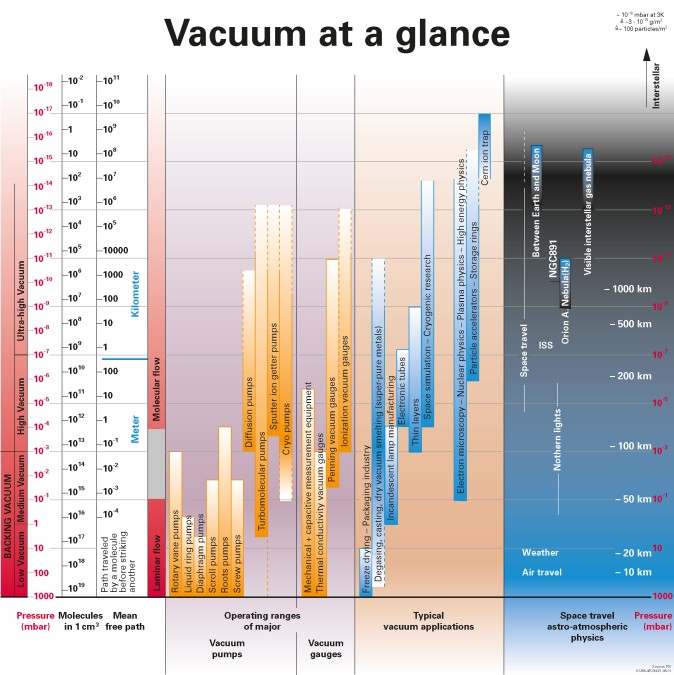
Figure 1.1: Overview of vacuum

-
test