


- Highly sensitive real-time, contamination monitoring
- Early detection of Airborne Molecular Contamination (AMC) in Front Opening Unified Pods (FOUPs)
- Multiple detection technologies
- Improved FOUP washer efficiency and optimized queue times
- SEMI S2/S8 compliant
Contamination Management Systems
Improving the yield in the semiconductor industry

With contamination management systems from Pfeiffer Vacuum+Fab Solutions, yields can be significantly improved at each step in the manufacturing of sensitive components such as chips or Integrated Circuits (ICs).
Discover our contamination management systems
APA 302

Benefits of the APA 302
Efficient contamination monitoring
The APA 302 is a unique in-line monitoring tool for advanced chip manufacturing in clean room environments. It provides highly sensitive, real-time measurement of Airborne Molecular Contamination (AMC) inside Front Opening Unified Pods (FOUPs). FOUPs are sealed, standardized transport and storage containers for silicon wafers.
They protect the wafers during queue times between process steps from moisture and AMC, such as hydrogen fluoride (HF). These contaminants can be released into the slot-to-slot space of a FOUP and may cause crystal growth on patterned wafers, leading to yield loss and performance degradation. By sampling the AMC through the FOUP filters, the APA 302 enables early contamination detection. It achieves detection limits in the ppb (parts per billion by volume) range.
With a measurement cycle of just two minutes, the system delivers high sensitivity. It uses ion mobility spectroscopy, flame ionization detection, UV fluorescence or cavity ring-down spectroscopy. When no FOUP is docked on the load ports, the APA 302 automatically monitors the surrounding clean room environment, ensuring continuous contamination control.
Reliable analysis of FOUP environment
To guarantee consistent performance, the APA 302 is equipped with an auto-calibration function that runs at regular intervals. The AMC monitoring can be performed in pods, such as FOUPs (Front Opening Unified Pods) or FOSB (Front Opening Shipping Boxes), with or without wafers, providing maximum flexibility for different process stages. FOUPs can be delivered either manually or through Overhead Hoist Transport (OHT) on the two load ports. The combination of these features optimizes queue times between individual process steps, enables immediate recognition of contamination increases, and improves overall yield reliability.
ADPC 302

Benefits of the ADPC 302
Efficient particle monitoring
Nanoparticles in the air and inside wafer transport carriers can damage semiconductor chips, causing significant yield loss. The innovative dry particle counter system ADPC 302 measures the number of particles in wafer transport carriers, including Front Opening Unified Pods (FOUP) and Front Opening Shipping Boxes (FOSB).
Using a fully automated, patented process, the system localizes and counts particles in the carrier, including the door. Qualified by leading semiconductor fabs, the ADPC 302 can be used for both serial manufacturing and R&D analysis. The main applications include carrier characterization, cleaning strategy optimization, and cleaning quality checks.
Advantages of the dry process
The dry particle counting process (dry particle counter) of the ADPC 302 offers clear benefits compared to the conventional method based on water consumption which is used in liquid particle counters. Unlike these traditional systems, the dry process is fully automatic and can be seamlessly integrated into the production line. This allows measurements to be carried out without interruption of the manufacturing process and without the need for additional operators. With a test time of only seven minutes, the ADPC 302 operates up to four times faster than liquid particle counters. As a result, the system can handle eight transport boxes per hour, compared to only two achieving with water consumption methods.
APR 4300
Benefits of the APR 4300
Reliable decontamination and protection
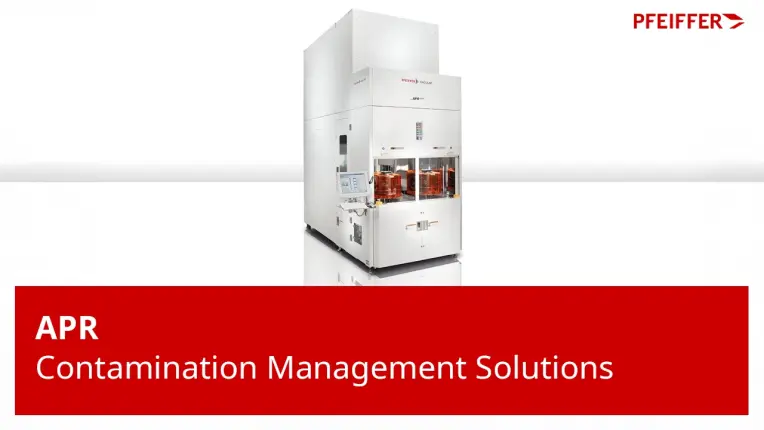
The APR 4300 is an advanced system designed to decontaminate wafers and protect them during queue time. In semiconductor manufacturing, Airborne Molecular Contamination (AMC) can adsorb on the surface of wafers and Front Opening Unified Pods (FOUPs), leading to crystal growth, yield loss, and reduced quality. The APR 4300 effectively prevents the adsorption of organic or inorganic molecules through a multiple-step process.
FOUPs are first conditioned to the desired operating pressure with laser-based deformation monitoring. The lasers are strategically placed in the upper part of the vacuum chamber directed at the FOUP. This ensures continuous and precise measurement of any surface changes or pressure variations within the FOUPs, thereby maintaining their integrity. Contaminants are then removed in a vacuum purge, during which targeted cleaning of contaminants and molecular impurities is achieved through repeated evacuation and venting. This process takes place in the four stacked vacuum chambers of the system.
After the vacuum purge, the chamber is flushed with pure nitrogen. This stabilizes the surfaces and prevents recontamination. In this way, the yield of a fab can be significantly increased and the queue times between the individual process steps can be optimized.
AMPC

Ambient multi-port controlling system
- Monitoring and analysis of contamination data, with transmission to fab control software for better process control and optimization
- Advanced analyzers and innovative valves
- AMPC extension frame: an optional unit for installing additional analyzers
- Software for sample management
- Data storage with real-time transmission and remote access
Benefits of the AMPC
Data management and fab communication
Airborne molecular contamination (AMC) is a major factor affecting yield in semiconductor fabs. To monitor and control contamination sources, Pfeiffer offers the AMPC – a unique solution for monitoring AMC in clean rooms and Equipment Front End Modules (EFEMs). Its innovative design with integrated valves incorporates up to 15 advanced analyzers using ion mobility spectroscopy, flame ionization detection or UV fluorescence to detect and quantify acids, bases, and organic compounds at up to 128 locations within a fab.
The AMPC extension frame provides 39 U of space for seven to nine analyzers. If monitoring of even more compounds is required, the system can be expanded by a second frame. All measurement data and tool parameters are stored in a database and transmitted via communication protocols of the fab, providing real-time monitoring of contamination levels. The software also allows users to set alarms when defined thresholds are exceeded and provides real-time access to measurement data via an Ethernet connection. This enables the semiconductor fab data to analyze the information and decide on appropriate actions.
Customer benefits
The AMPC provides fabs with immediate insights into contamination levels, supporting rapid decision-making and process control. With high throughput, it completes analyses in just three minutes, enabling fast responses and timely actions. Its design prevents cross-contamination between sampling lines, ensuring reliable data across all monitored locations. Scalable analyzer and sampling-line configurations allow for centralized monitoring, reducing operational complexity and enhancing overall fab efficiency.
AMC Track

Benefits of the AMC Track
Enabling agile AMC monitoring
Increasingly complex and dynamic Airborne Molecular Contamination (AMC) risks in semiconductor fabs require a tool with greater flexibility and reactivity than fixed monitoring alone can provide.
AMC Track is a compact and highly maneuverable mobile solution to complement the AMPC monitoring system by bringing agility and speed to AMC control in semiconductor fabs. This tool helps quickly investigate and identify localized contamination risks and respond rapidly to unexpected events.
Driving performance and reliability
AMC Track enables fast fab mapping, real-time leak detection, and rapid AMC crisis troubleshooting, helping teams act immediately where it matters most. The system features automated data acquisition, seamless data transfer as well as the ability to read and record digital and analog signals, ensuring full operational flexibility. It accelerates fab ramp-up, tool qualification and process validation, while identifying optimal monitoring locations within the fab.
As a result, the AMC Track helps reduce downtime, accelerate deployment and increases yield protection through smarter, more agile AMC control.
FAQ
How does contamination occur?
In the semiconductor industry, wafer outgassing can take place during transport or queue time. Moisture and Airborne Molecular Contaminants (AMC), such as hydrogen fluoride (HF), which originate from process gases, chemicals and materials in the surrounding process environment, react in the confined spaces of transport boxes (pod systems) with oxidants from the ambient air (H₂O and O₂). These reactions cause crystal growth on structured wafers, leading to reduced quality and lower manufacturing yield.
In the pharmaceutical industry, contamination such as humidity, oxygen or microbiological ingress can impact drug stability throughout the product life cycle.
What makes contamination systems from Pfeiffer special?
With decades of experience in vacuum technology, Pfeiffer has developed extensive know-how of processes, equipment and environment of production systems. Leveraging this expertise, we provide advanced contamination management solutions for the semiconductor and pharmaceutical industries. Our systems detect and minimize contamination, thereby increasing yield at each step of the process.
Ensuring high-quality manufacturing and maximizing yield requires detailed knowledge of contaminants on wafers, in transport carriers (Front Opening Unified Pods, FOUPs), and in their immediate environment, such as clean rooms or EFEMs (Equipment Front End Modules), so that monitoring, decontamination, and real-time process control can be applied effectively.
In semiconductor industry, continuous in-line monitoring is achieved with the APA 302, while the fully automated ADPC 302 localizes and counts particles on the inner surfaces of transport carriers. The APR 4300 decontaminates wafers and FOUPs and protects them during queue times. For clean room and Equipment Front End Modules (EFEM), the AMPC provides centralized, real-time contamination data, enabling rapid decision-making and efficient fab management.