Please update your browser. It looks like you are using an old version of the Microsoft Edge browser. To get the best experience with the Pfeiffer website, please update your browser.

Vacuum Chambers

Standard and customized vacuum chambers for research and advanced manufacturing

vacuum_chambers_new

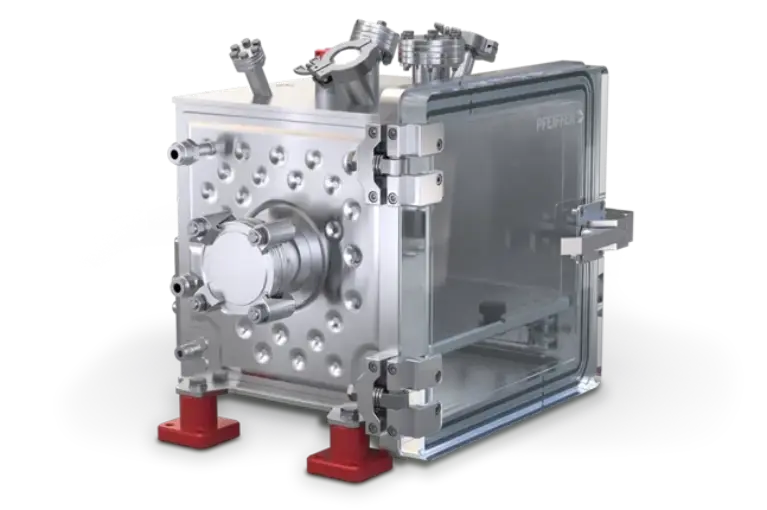
Our standard, modular, and fully custom vacuum chambers are made of stainless steel and special alloys. Engineered for medium vacuum, high vacuum, and ultra-high vacuum (UHV) applications, they excel in drying, plasma processes, and surface studies.

Vacuum chambers - from medium to ultra-high vacuum

Vacuum chambers from Pfeiffer form the heart of any vacuum system. Whether a process calls for low, medium, high or ultra-high vacuum, our chambers meet the highest technical and engineering requirements. Our experts design them in close collaboration with our customers according to the needs of their individual process.

Our chambers can also be designed, produced, and tested as pressure chambers for overpressure exceeding 500 hPa (mbar) in accordance with the Pressure Equipment Directive (2014/268/EU).

Standard vacuum chambers

Our range of standard vacuum chambers offers a quick availability and cost-efficient alternative to custom-built designs.

Through the combination of standardized basic bodies with freely selectable chamber ports, flanges, and further components we create a chamber tailored to your application.
  • medium_vacuum_chambers

    Medium vacuum chambers

    Operate at pressures between 10⁻¹ to 10⁻³ bar (mbar), suitable for a wide range of industrial applications like leak testing or packaging.

    Learn more
  • high_vacuum_chambers

    High vacuum chambers

    Operate at pressures between 10⁻³ to 10⁻⁷ hPa, typically using turbomolecular or diffusion vacuum pumps.

    Learn more
  • con23_977_graphicspvvacuumchambers_image_3_767x510px_wip_sv

    Ultra-high vacuum chambers

    Designed to operate at pressures below 10⁻⁷ hPa, typically used in research and other UHV applications.

    Learn more
  • modular_vacuum_chambers

    Modular vacuum chambers

    Customizable to allow modification of size and configuration for specific experiments or processes.

    Learn more
  • chambers_for_mass_spectrometers

    Chambers for mass spectrometers

    Designed to maintain ultra-high vacuum, ensuring the accuracy of ionization and ion detection.

    Learn more

Medium vacuum chambers

Designed for vacuum conditions from 1000 hPa to an ultimate pressure down to 10⁻³ hPa (mbar) for a wide range of industrial applications.

Examples for applications from the rough vacuum range to atmosphere in industry are vacuum drying, packaging, degassing and a variety of research tasks that do not require high or ultra-high vacuum conditions.

With a design that combines robustness and cost-efficiency, these chambers have become a practical choice for universities, pilot plants, and general industrial settings.
con23_977_graphicspvvacuumchambers_image_6_767x767px_wip_sv

High vacuum chambers

High vacuum chambers provide stable vacuum environments down to approximately 10⁻⁷ Pa, creating the conditions required for processes like plasma treatment, thin-film coating, and analytical instrumentation.

Our high vacuum chambers can be equipped with ISO-KF, ISO-K, ISO-F or CF flanges. Viewports are available for direct observation of running processes. Engineered to minimize contamination, accelerate pump-down, and simplify maintenance, these vacuum chambers are ideal for manufacturing and advanced R&D applications where UHV is not required.
con23_977_graphicspvvacuumchambers_image_7_767x767px_wip_sv

Ultra-high vacuum (UHV) chambers

Essential in scientific, industrial and semiconductor applications where pressures below 10⁻⁷ Pa are required.

Ultra-high vacuum applications are sensitive even to trace gases. UHV chambers provide the required vacuum conditions for these experiments. Made from bakeable stainless steel and equipped with CF metal-sealed flanges, UHV chambers ensure minimal outgassing and long-term stability for applications in surface science, particle physics, nanotechnology, and next-generation semiconductor research.
con23_977_graphicspvvacuumchambers_image_8_767x767px_wip_sv

Modular vacuum chambers

Customizable to allow modifications in size and configuration for specific processes. Modular vacuum chambers are designed with flexibility at their core. Constructed from standardized building blocks, their chamber size, ports, and flanges can be tailored to match the specific requirements of individual research or industrial processes.

This design approach reduces lead times and costs compared to fully custom designs, while still providing the performance needed for demanding applications such as coating, thin-film deposition or leak detection.
con23_977_graphicspvvacuumchambers_image_9_767x767px_wip_sv

Vacuum chambers for mass spectrometers

Designed to maintain ultra-high vacuum, ensuring accurate ionization and ion detection.

Mass spectrometry requires precise, clean, and stable vacuum conditions – and our chambers for mass spectrometers are engineered to meet that demand. They minimize background noise and contamination while providing reliable ports for ion sources, detectors, and vacuum pumps.

With compact footprints and customizable ports, they integrate seamlessly into analytical systems, enabling accurate and reproducible measurement results in both laboratories and industrial environments.
con23_977_graphicspvvacuumchambers_image_10_767x767px_wip_sv

Custom vacuum chamber solutions

Not every process fits a standard off-the-shelf chamber. That is why we design each chamber to meet your exact requirements. Size, geometry, material, and vacuum level are all tailored to your application. Where needed, we can also create matching UHV manifolds for precise vacuum and gas distribution.

Customers can choose:

  • Material: stainless steel or special alloys (e.g. aluminum)
  • CF viewports for UHV
  • Cooling and heating
  • Cleanroom assembly
  • Full documentation
  • Advanced surface finishing (grinding, electropolishing)
  • Component rack
  • Factory acceptance test
  • Accessories such as power feedthroughs, vacuum manipulators, valves

We build your system in house and complete the process with extensive helium leak testing. Upon request, we can also deliver a complete vacuum system, including vacuum pumps, vacuum measurement equipment, components, and valves.

Get in contact with our experts
customized_vacuum_chamber

FAQ

What is a vacuum chamber?

A vacuum chamber is a sealed vessel from which air and gases are removed to create a controlled low-pressure environment.

This provides the clean, stable conditions required for processes such as thin-film coating, semiconductor manufacturing, space simulation, analytical science, and research experiments.

Depending on design, vacuum chambers can provide medium vacuum, high vacuum, or ultra-high vacuum (UHV) conditions. They are typically made from stainless steel or other materials such as aluminium alloys.

What is the difference between a vacuum chamber and a vacuum vessel?

There is no difference – the terms vacuum vessel and vacuum chamber are used interchangeably to describe a sealed vessel from which gases and air are removed to create a low-pressure environment.

What vacuum ranges do Pfeiffer chambers cover?

Our vacuum chambers are available for medium, high, and ultra-high vacuum (UHV) applications.

  • Medium vacuum chambers provide controlled environments in the rough to high vacuum range. They are well suited for applications such as vacuum drying, packaging, degassing, and certain research tasks that do not require high or ultra-high vacuum.
  • High vacuum chambers provide stable environments down to approximately 10⁻⁷ hPa (mbar), supporting processes like plasma treatment, thin-film coating, and analytical instrumentation.
  • Ultra-high vacuum chambers reach pressures below 10⁻7 hPa (mbar) for experiments where even trace gases negatively influence results. By using bakeable stainless steel and CF flanges, these vacuum chambers minimize outgassing and deliver long-term stability for surface science, particle physics, nanotechnology, and next-generation semiconductor research.

Why is stainless steel the preferred material for vacuum chambers?

Stainless steel is the preferred material for vacuum chambers because it is corrosion-resistant, can be baked out at high temperatures, and maintains extremely low leak and permeation rates.

What kinds of surface treatment and finishing are possible for a vacuum chamber?

Various surface treatments and finishes can be applied to achieve the necessary cleanliness, smoothness, and chemical resistance in a vacuum chamber required for a particular application.

Minor imperfections can be removed through glass-bead blasting, creating a uniform texture. Grinding is used to eliminate unevenness and achieve a consistent finish. Chemical processes such as acid dipping and passivating help to clean. For UHV applications, electropolishing is employed to produce an ultrasmooth, contaminant-free surface. Finally, anodic cleaning can further stabilize and remove contaminants.

How to choose the right material for your vacuum chamber

The choice of material depends on the requirements of the application. Stainless steel is ideal for UHV applications due to its low outgassing and ability to withstand bake out, whereas aluminum is preferred when a lightweight chamber is needed.

Chamber type
Best for
Key advantages
Limitations
Stainless steel
  • Durable
  • Bakeable
  • High costs
Aluminum
Lightweight setups such as prototypes and transportable or modular systems
  • Light
  • Relative magnetic permeability
  • High costs
  • Requires special welding techniques

Not sure what's best for your needs?
Speak to our experts

How to design an ultra-high vacuum chamber

An ultra-high vacuum chamber typically requires careful consideration of the following critical aspects:

  • Material choice: Austenitic stainless steel is preferred due to its low gas content and high corrosion resistance.
  • Thermal management: All materials, including those of individual components, must withstand bake-out temperatures to minimize outgassing. Stainless steel pairs well with copper due to their similar thermal expansion rates, whereas aluminum is more limited, particularly at high temperatures.
  • Welding and fabrication: Internal welds are favored to avoid virtual leaks, while twin welds should be avoided as they can trap gases. The design should also minimize blind holes and rough surfaces.
  • Cleaning process: Final preparation often includes an ultrasonic bath, a rinse with demineralized water, and vacuum annealing. Together, these ensure minimal contamination.

Additionally, controlling tracer gas flows during leak testing is essential. Tools such as short gas lines, helium spray guns, and two-stage reducers help maintain accuracy and minimize leaks.

Learn more about the generation of ultra-high vacuum.

What shapes can vacuum chambers from Pfeiffer be built in?

Vacuum chambers can be manufactured in a variety of shapes and geometries to match the process. Standard designs include cylindrical (horizontal or vertical), cubical, and rectangular chambers, available in multiple diameters and lengths.

For specialized setups, we also build custom geometries with added ports, domes, or hybrid shapes. This flexibility ensures an optimized vacuum environment whether the application is semiconductor applications, coating, space simulation, or analytical research.

What is outgassing in a vacuum chamber, and how do Pfeiffer chambers reduce it?

Outgassing is the release of trapped gases or vapors from materials inside a chamber, which can limit achievable vacuum levels.

Vacuum chambers from Pfeiffer are typically made from stainless steel and can be electropolished, chemically passivated, and vacuum annealed to minimize outgassing and ensure stable long-term performance.

Can vacuum chambers from Pfeiffer be customized for my application?

Yes. Pfeiffer offers tailored vacuum chamber solutions, including non-standard sizes, special alloys, transparent chamber doors, water cooling or heating (pillow plate), heating jackets, cleanroom assembly, and integration with vacuum pumps, gauges, and leak detectors from our own portfolio.

Contact us

What is a pillow plate?

A pillow plate is a fully welded plate consisting of two superimposed metal sheets joined by a weld along the edges and an internal dot pattern. After welding, the plate is hydraulically inflated to generate a hollow space between the sheets, allowing a heating or cooling medium to circulate. The hollow, inflated structure makes pillow plates lightweight, stable, and durable.

Pillow plates serve two main purposes:

1. They help achieve the required vacuum conditions quickly because they allow the optimal temperature within the chamber, and therefore certain beneficial conditions, to be met.
Heating the chamber walls accelerates the desorption of residual gases. Cooling can be used to reduce outgassing and stabilize processes once the base pressure is reached.

2. They provide a stable and uniform temperature across the chamber, minimizing the effect of ambient temperature on the process. This is particularly important for temperature-sensitive applications, such as optical processes. This also helps improve energy efficiency as temperature fluctuations are reduced and therefore do not need to be compensated for.

What advantages do the vacuum chambers from Pfeiffer offer?

With our high-quality vacuum chambers for both individual and series production, we provide tailored vacuum technology for demanding applications.

Pfeiffer provides allparts of the process from a single source, including application consulting, design, fabrication, quality assurance, assembly and on-site service.

Key advantages of our vacuum chambers:

  • State-of-the-art welding technology:
    • Precision welding machines for all types of metals
    • Laser and orbital laser welding in a separate room (gray room)
    • Laser weldings with up to 8 kW for faster welding and greater depths (up to 16 mm)
    • Material thickness ranges from 0.1 mm up to approximately 20 mm – from very thin to thick
  • Comprehensive quality control:
    • Leak testing of all manufactured vacuum chambers
    • Optional residual gas analysis to ensure maximum vacuum integrity
    • Holistic technology and process control for vacuum product welding
  • Flexible vacuum solutions:
    • Vacuum chambers and components up to 3,000 mm x 2,000 mm x 2,000 mm
    • Adaptable to customer-specific technical requirements
    • Flexible equipment options tailored to your needs
    • For medium vacuum to ultra-high vacuum
  • Complete service from a single source:
    • Personalized consulting, planning, and manufacturing
    • On-site assembly and commissioning
    • Full-service package for maximum efficiency

Are Pfeiffer vacuum chambers built under a certified quality system?

Yes, vacuum chambers from Pfeiffer are manufactured according to a certified quality system. Furthermore, they comply with international standards.

Our certifications at a glance:

  • Quality management system: ISO 9001 – with documented processes and full traceability
  • Welding manufacturer: DIN EN ISO 3834-2 – comprehensive quality requirements for fusion welding of metallic materials
  • Weld seam quality:DIN EN ISO 5817 – standardized weld quality levels
  • Pressure vessel manufacturer: AD 2000-Merkblatt HP0 – approved standards for pressure equipment
  • Welder qualification: DIN EN ISO 9606-1 – certified welder testing
  • Operation qualification:DIN EN ISO 14732 – operator certification for automated welding systems
  • Visual testing certification: VT1
  • Helium leak detection certifications: LT1 / LT2ö

With these certifications, Pfeiffer ensures that every vacuum chamber meets stringent technical standards for safety, reliability, and long-lasting performance.