Please update your browser. It looks like you are using an old version of the Microsoft Edge browser. To get the best experience with the Pfeiffer website, please update your browser.

Vacuum Pump Oil and Operating Fluids

The right mineral, synthetic diester or perfluoropolyether (PFPE) oil makes a difference to vacuum pump performance.

oil

Vacuum pump oil types and specifications in the Pfeiffer portfolio

Vacuum pump oil must meet the mechanical, thermal and chemical requirements of both the pump and the process. The right oil properties ensure reliable lubrication, heat management and, where required, sealing throughout operation.

Mineral, diester and PFPE oils cover a wide range of vacuum applications and operating conditions.

Find the full range in our shop

Mineral oils for a wide range of applications

Mineral oil or mixtures of mineral and synthetic oil (mineral- /synthetic blends) are sufficient for most applications.

If water vapor may condense in the pump, oils with anti-emulsifying properties can help separate water from the oil within certain limits. Certain double-distilled mineral oils reduce oil backflow or are resistant to corrosive gases and ionizing plasma.
  • oilcanister_p3_5l_1200x675px_72dpi_rgb_ll

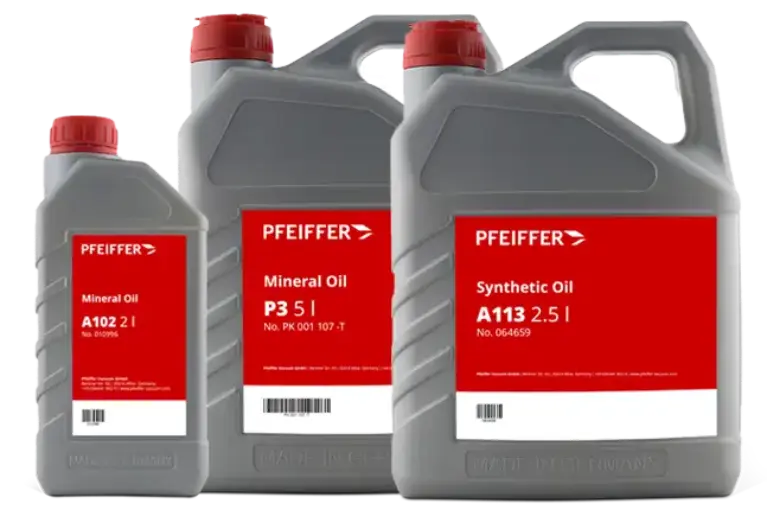
    P3

    Standard mineral oils, oxidation-resistant

    Shop now
  • oilbottle_a102_2l_1200x675px_72dpi_rgb_ll

    A102

    Mineral oils with anti-emulsifier for drying and pumping of water vapor or freeze-drying

    Shop now
  • oilbottle_a111_2l_1200x675px_72dpi_rgb_ll

    A111

    Mineral oils with anti-emulsifier, oxidation-sensitive (no cyclic pumping at or above atmospheric pressure)

    Shop now
  • oilbottle_a119_1l_1200x675px_72dpi_rgb_ll

    VMA 055/A119

    Standard mineral oils; conveyance of non-corrosive gases

    Shop now
  • oilbottle_a120_2l_1200x675px_72dpi_rgb_ll

    A120

    Standard mineral oils; conveyance of non-corrosive gases

    Shop now
  • oilbottle_a121_1l_1200x675px_72dpi_rgb_ll

    A121

    Mineral oils with anti-emulsifier; resistant to acids and organic vapors

    Shop now
  • oilbottle_a200_1l_1200x675px_72dpi_rgb_ll

    A200

    Mineral oils with anti-emulsifier

    Shop now
  • oilbottle_a300_1l_1200x675px_72dpi_rgb_ll

    A300

    Mineral oils with anti-emulsifier; highly resistant to ionizing plasma

    Shop now

Perfluoropolyethers (PFPE) for aggressive and reactive media

Perfluoropolyether lubricants are the most chemically stable operating fluids for vacuum pumps.

They are typically used for pumping aggressive or reactive media such as oxygen, ozone, halogens such as fluorine, organic and inorganic solvents, and gases like HCl (hydrochloric acid), BF₃ (boron trifluoride), HF (hydrogen fluoride).
  • oilcanister_a113_2_5l_1200x675px_72dpi_rgb_ll

    YLC 250 B/A113

    For rotary vane vacuum pumps and dry technologies

    Shop now
  • oilbottle_f3_0_25l_1200x675px_72dpi_rgb_ll

    F3

    For turbomolecular vacuum pumps

    Shop now
  • oilbottle_f4_1l_1200x675px_72dpi_rgb_ll

    F4

    For rotary vane vacuum pumps with a pumping speed < 20 m3/h

    Shop now
  • oilbottle_f5_1l_1200x675px_72dpi_rgb_ll

    F5

    For rotary vane vacuum pumps with a pumping speed > 20 m3/h

    Shop now

Choosing the right vacuum pump oil

Your pump’s operating instructions are the first place to check for suitable oils. In general, the right choice is narrowed down based on five key factors:

Pump technology and design

Oil performs different functions depending on the pump design. It may be used directly in the compression chamber for lubrication and sealing, or lubricate gears and bearings outside the gas path in dry vacuum pumps and boosters.

Operating temperature

Temperature affects oil viscosity and ageing. The oil must maintain suitable lubricating properties across the pump’s operating temperature range.

Process media and chemical exposure

Process gases and vapors can interact with the oil. Chemical resistance and compatibility therefore become particularly important when handling reactive or corrosive media, solvents or high concentrations of water vapor.

Application and operating conditions

Operating hours and load influence the demands placed on the oil. Continuous and intermittent operation may therefore call for different oil properties.

Special requirements

Some applications impose additional requirements beyond pump performance. These can include food-grade lubricants or specific material and process compatibility requirements.

Which vacuum pump oil do I need - a selection guide

Use this guide to compare oil types and identify which oil group best matches your application and operating conditions. It provides a starting point for selecting the right oil for your vacuum pump.

Oil type
Temperature range
Chemical resistance
Suitable media
Performance characteristics
Typical applications
Standard operating temperatures (up to approx.
95 °C)
Varies by formulation; selected double-distilled variants offer increased resistance to corrosive gases and ionizing plasma
Air, noble gases, water vapor; selected variants also for corrosive process media
Low vapor pressure, good demulsibility, stable lubrication
General vacuum applications; processes with moisture/condensables
Up to 120 °C
Resistant to mildly corrosive media; enhanced oxidation stability
Low solvent concentrations
Stable viscosity at high temperature; prolonged oil service life
High-temperature vacuum processes; mildly corrosive environments
High thermal stability
Highest chemical stability; inert to aggressive and reactive gases
Oxygen, ozone, halogens (incl. fluorine); HCl, BF₃, HF, PO₃; solvents
Resists oxidation and contamination; maintains performance under extreme conditions
Semiconductor, thin-film, corrosive and reactive processes

Keep oil changes and maintenance on track

Regular oil changes help maintain vacuum performance and protect your pump over its service life. If you are unsure which oil to choose, when to change it or need technical support, our experts are here to help.

Condition monitoring uses operating data such as pump temperature to provide early indications of oil status and help you plan maintenance.

Our service specialists can take care of scheduled maintenance and oil changes, freeing up your own maintenance resources.

For more details on oil-change, see our FAQ section.
service_worker_product_service_cropped

Synthetic diester lubricants for high-temperature applications

Synthetic diester lubricants are used when higher thermal stability or greater resistance to aggressive gases is required.

They are suitable for temperatures up to 120°C. In two-stage rotary vane vacuum pumps, the achievable ultimate pressure with synthetic diester oil is approximately one order of magnitude lower than with mineral oil.
  • oilcanister_d2_5l_1200x675px_72dpi_rgb_ll

    VSC 100/D2

    High thermal stability, for rotary vane vacuum pumps and vacuum booster

    Shop now

FAQ

What are the different types of vacuum pump oil and their uses?

Vacuum pump oils differ in chemical composition, temperature limits and chemical resistance. The three main types are mineral (hydrocarbon-based), synthetic diester and PFPE oils:

  • Mineral oils are suitable for a wide range of general vacuum applications, including pumping air, noble gases and water vapor.
    When selecting a mineral oil, important properties include low vapor pressure, good demulsibility, thermal stability and suitable viscosity. If water vapor may condense in the pump, oils with anti-emulsifying properties help separate water from the oil. Certain highly refined or double-distilled mineral oils can also reduce oil backflow or provide resistance to corrosive gases and ionizing plasma.
  • Synthetic diester oils are used when higher thermal stability or greater resistance to aggressive gases is required. They are suitable for temperatures up to 120 °C.
    Besides offering higher thermal stability than mineral oils, synthetic diester oils allow two-stage rotary vane vacuum pumps to achieve a better ultimate pressure, typically by about one decade.
  • PFPE (perfluoropolyether) oils are typically used when standard mineral oils or synthetic diester oils may degrade too quickly due to aggressive or reactive process media (such as oxygen, ozone, halogens, solvents and corrosive gases).
    Their exceptional chemical stability helps resist oxidation, prevent sludge formation and maintain lubricant performance under demanding process conditions. This stability can support extended oil service life and deliver reliable performance in semiconductor, thin-film and laboratory environments.

Can I mix different vacuum pump oils?

Mixing oil types is not recommended. Not even if there's still half a canister on the shelf that isn't enough for a full fill-up.

Different vacuum pump oils should not be mixed unless they are explicitly approved as compatible. Different oil types and formulations can have incompatible properties, which may affect lubrication, chemical stability and vacuum performance.

Mixing can also occur unintentionally when switching to a different oil. Residues of the previous oil may remain in the pump and affect the properties of the new oil. Before switching, the existing oil should therefore be drained thoroughly. Depending on the oils involved, cleaning or flushing may be required.

Always make sure the new oil is compatible with the vacuum pump, process media and operating conditions, and follow the pump-specific instructions when changing oil type or grade.

How often should I change the vacuum pump oil?

There is no single oil change interval for every vacuum pump. The required interval depends on the pump technology, operating hours and process conditions. Temperature and exposure to process media can accelerate oil ageing and may require more frequent oil changes.

Always use the maintenance schedule specified for your pump as the starting point and adapt it to the actual operating conditions where necessary.

Change the oil when you notice:

  • Increase in operating temperature
    If the pump is running hotter than usual, it could be a sign that the oil has degraded and is no longer providing adequate lubrication or heat dissipation.
  • Oil contamination
    If you notice any signs of contamination, such as the presence of debris or water in the oil, it is time to replace it. Contaminants can cause damage to the pump and affect its performance.
  • Loss of vacuum performance
    If your pump’s ability to maintain vacuum starts to decline, it could indicate that the oil has lost its efficiency and needs to be replaced.
  • Oil color change
    A noticeable change in oil color is a warning sign that should not be ignored.
    It can indicate ageing, contamination or reactions with process media. Depending on the cause and the condition of the oil, this may require an oil change or closer monitoring. Keep in mind that the extent of discoloration also depends on the oil type: mineral oils tend to darken noticeably as they age, while oils with higher oxidation resistance generally show less color change. Depending on the oil type, degradation may also appear as cloudiness, sludge, deposits or visible precipitates Less discoloration does not necessarily mean less degradation.

Regularly monitoring the oil's appearance and performance will help ensure that your vacuum pump continues to run efficiently. When in doubt, change out.

Please note that oil can age not only during storage and eventually reach the end of its shelf life, but also in a pump that is not being used. Depending on the period of inactivity, the oil may need to be replaced before the pump is put back into operation.

If you need help: Contact us.

How can I extend vacuum pump oil service life?

Oil service life depends strongly on operating conditions. Where applicable, several measures can help reduce oil degradation and extend service intervals:

  • Use the gas ballast to reduce condensation of water vapor and other condensable process media in the oil.
  • Maintain the correct operating temperature, as excessive heat accelerates oil oxidation and degradation.
  • Use suitable filters to reduce contamination from particles and process residues.
  • Monitor the oil condition regularly to detect degradation before it affects pump performance.
  • Avoid unnecessary shutdowns, as repeated cooling phases can promote condensation in the pump and accelerate oil degradation.

Always consider the pump technology and process conditions, as the appropriate measures and achievable oil service life vary with the application.

If your vacuum pump oil is not lasting as long as expected, talk to us. Together, we can look at the operating conditions and check if there are better options available.

Contact us

What happens if I do not change my vacuum pump oil regularly?

Vacuum pump oil can degrade over time and through exposure to process media. As its properties deteriorate:

  • Viscosity and lubricating performance can decrease.
  • Oxidation can lead to sludge and deposits that restrict oil passages.
  • In oil-sealed vacuum pumps, degraded oil can reduce internal sealing effectiveness and affect vacuum performance.
  • Insufficient lubrication and higher operating temperatures can increase wear and shorten pump lifetime.

Oil degradation is unavoidable. The key is to change the oil before it leads to premature wear and damage. This leads to the practical question: How do I change the oil in my vacuum pump?

The exact procedure depends on the vacuum pump. In general, the oil is drained while the pump is warm, replaced with the specified oil and filled to the correct oil level. Oil filters and exhaust filters should also be checked and replaced according to the pump’s maintenance schedule.

A few points are particularly important:

  • Remove as much of the old oil and its residues as possible. Remaining degraded oil, sludge or deposits can contaminate the fresh oil and accelerate its degradation.
  • Follow the operating instructions for your pump. They contain the pump-specific oil grade, filling quantity and maintenance procedure and are available on the respective product pages.
  • Handle used oil safely. Wear appropriate protective equipment and collect the oil for proper disposal.

If you prefer to leave the oil change and related maintenance to us, Pfeiffer Service can take care of it for you.

Contact us

Why choose Pfeiffer genuine vacuum pump oils?

Pfeiffer oils are developed and tested for use with our vacuum pumps. This gives you confidence that the oil does more than meet a specification. It performs as required in the pump and under its operating conditions.

Tested compatibility


  • Developed and tested for Pfeiffer vacuum pumps
  • Stable vapor pressure for reliable ultimate vacuum
  • Strong lubrication and sealing performance


Reliable performance


  • Stable viscosity across the operating temperature range
  • Effective heat transfer supports efficient pump operation
  • Stable vapor pressure for reliable vacuum performance


Protection against premature wear


  • Strong lubrication protects moving components
  • Resistance to oil degradation helps prevent sludge formation
  • Reliable lubrication supports long pump lifetime

Can I use generic oils and lubricants in my Pfeiffer vacuum pump?

Generic oils may have similar specifications, but this does not necessarily mean they will perform the same way in the pump. Pfeiffer oils are selected and tested with our vacuum pumps to verify their compatibility and performance under real operating conditions.

An untested oil may provide insufficient lubrication or heat transfer, degrade more quickly or form sludge and deposits. In oil-sealed pumps, unsuitable oil properties can also affect internal sealing and ultimately vacuum performance. Over time, this can contribute to higher operating temperatures, increased wear and shorter pump lifetime.

For this reason, we recommend using the oil specified for your Pfeiffer vacuum pump.

Can I use Pfeiffer vacuum pump oils also in third-party vacuum pumps?

Basically yes, Pfeiffer vacuum pump oils can also be used in third-party pumps, provided the selected oil meets the requirements of the pump and application. Compatibility must be assessed individually for the specific pump model, materials, operating conditions and process.

Since third-party pumps are not part of our qualification testing, Pfeiffer cannot verify material compatibility or performance in these pumps. We therefore recommend considering the pump manufacturer’s specifications, particularly while the equipment is under warranty.