Please update your browser. It looks like you are using an old version of the Microsoft Edge browser. To get the best experience with the Pfeiffer website, please update your browser.

space_research_stage

Vacuum for Space Simulation and Research

Advanced vacuum and thermal vacuum chambers reproduce the low pressures, thermal extremes, and clean conditions found in outer space.

They allow spacecraft hardware, propulsion systems, and materials to be evaluated under realistic mission environments on Earth.

Contact us

How can space conditions be simulated on Earth?

Accurate testing is essential before any system operates in orbit. Pfeiffer Vacuum+Fab Solutions enables stable, contamination-controlled environments that replicate the low pressure and wide temperature range of space.

By ensuring reproducible results under extreme conditions, Pfeiffer helps customers shorten qualification cycles, prevent test failures, and verify component reliability long before launch.

Product portfolio

Pfeiffer provides the technologies needed to create clean, stable, and reproducible vacuum conditions for all space-research applications – from laboratory setups to spacecraft qualification and propulsion testing.

Our systems deliver the pumping speed, pressure stability, and measurement accuracy essential for reliable results.

Being a member of the Busch Group, the Pfeiffer portfolio is complemented by products from Busch Vacuum Solutions, providing robust rough vacuum capacity and high-throughput performance for demanding environments. Together, we cover the entire vacuum range needed for space simulation, thermal vacuum testing, and propulsion applications.

Compare matching products

Applications in space simulation and research

Vacuum technology from Pfeiffer is used in facilities such as Justus Liebig University Giessen, Nammo, and IFPiLM Warsaw.

Our systems support a wide range of space-research tasks – from thermal vacuum qualification to propulsion testing and material investigations – providing the pressure stability, cleanliness, and long-term reliability these experiments require

con23_972_pvspacesimulation_image_1_exact_767x767_sv_no_background

Thermal vacuum testing

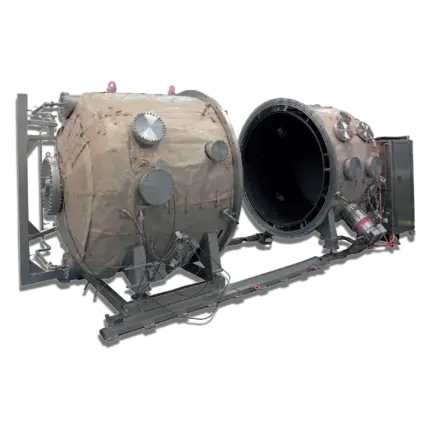
Thermal vacuum testing in a thermal vacuum chamber (TVAC) combines stable low-pressure conditions with defined temperature ranges over long durations to ensure consistent component behavior under simulated space environments. For space-related applications, this often includes temperatures from -80 °C up to >150 °C, which require dedicated cooling or heating concepts inside the vacuum chamber.

To achieve these conditions, chambers can be equipped with a thermal shroud – also referred to as a cold shroud or thermal shield – connected to thermofluid thermostats capable of reaching such temperatures. The shroud provides uniform surfaces and stabilizes thermal behavior during cycling.

Structural integrity is confirmed using helium leak testing, which offers the sensitivity needed to detect very small leak rates in welded structures for thermal vacuum applications. Interior surfaces can be electropolished or prepared with other low-outgassing finishes to maintain clean and stable vacuum conditions throughout the test.
Contact us
con23_972_pvspacesimulation_image_2_exact_767x767_sv

Propulsion testing

Propulsion tests place different demands on the vacuum system.

Electric thrusters require low background pressure to prevent facility effects on exhaust expansion and beam characteristics, while chemical engines produce high and rapidly changing gas loads during ignition.

The pumping concept must therefore be adapted precisely to the propulsion technology and its load profile.
Contact us

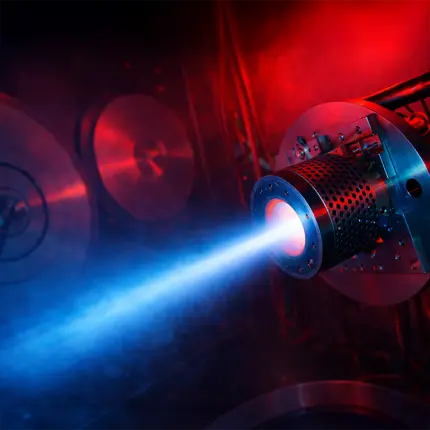
Electric propulsion testing

Tests for ion engines like radio-frequency ion thrusters, Hall-effect thrusters, and other plasma-based propulsion systems require vacuum environments where background pressure and propellant partial pressure are kept low enough to avoid facility-induced alterations of exhaust expansion and beam characteristics.

Depending on thruster type and propellant flow, operating pressures typically range from the 10-7 hPa (mbar) regime to several 10-5 hPa (mbar).

Electric propulsion commonly uses noble propellant gases such as xenon or krypton, whose high molecular weight and flow rates impose significant demands on the vacuum system.

Pfeiffer provides scalable pump concepts – from compact turbomolecular vacuum pump units for laboratory setups to high-throughput systems for full-scale thruster testing. They are designed to maintain stable pressure under continuous noble-gas load. Integrated pressure measurement and residual gas analysis (RGA) allow continuous monitoring of gas composition and verification of the facility’s test envelope during operation.

Chemical propulsion testing

Chemical propulsion tests, including those for rocket engines, generate very high gas loads and abrupt load transitions, especially during ignition. To maintain stable back pressure under these conditions, the vacuum system must deliver high pumping speed and respond rapidly to changing throughput.

Pfeiffer achieves this with its vacuum booster pump units that combine vacuum boosters with dry screw pumps. This design distributes the gas load across several stages, prevents thermal overload, and provides the required throughput in the rough and medium vacuum range.

Frequency-controlled operation
enables the pumping speed to match the transient gas load. System performance can be verified with large-orifice step-load tests that reproduce the expected load profile before firing.

In explosive environments where flammable propellants or ignition sources must be considered, ATEX-compliant configurations are available.

con23_972_pvspacesimulation_image_3_exact_767x767_sv

Telescope coating and optical components

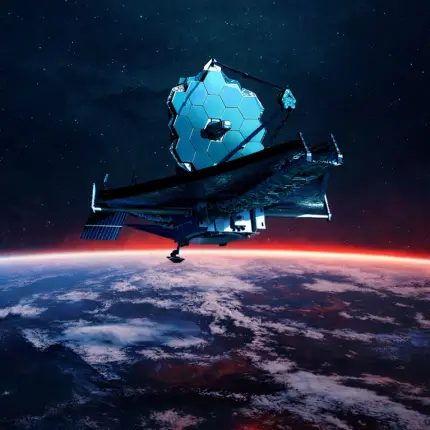
Optical coating of large mirrors and precision detectors requires a high vacuum environment where background pressure is minimized and process gas throughput is tightly controlled. This reduces particle incorporation, scattering, and other defects that degrade optical performance.

Pfeiffer supplies customized vacuum systems to manage both the base vacuum level and the gas loads from deposition processes. Chambers are electropolished or processed with other low-outgassing internal finishes to support clean, stable conditions.

Residual gas analyzers (RGA) can be integrated to monitor gas composition in real time. The coordinated integration of pumps, gauges, valves, and the chamber interface enables reproducible vacuum conditions for uniform, high-precision optical coatings.
Contact us

Vacuum bake-out and outgassing studies

con23_972_pvspacesimulation_image_4_exact_767x767_sv
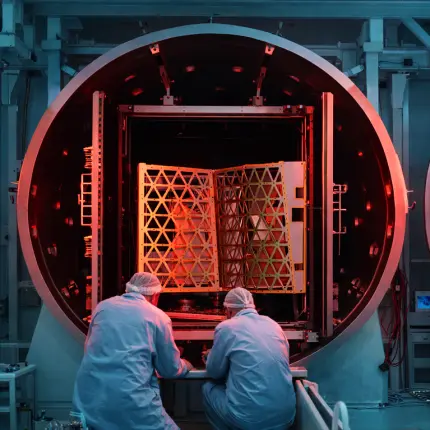
Bake-out and outgassing tests require vacuum conditions that remain stable while components are heated to remove adsorbed water and volatile compounds. These procedures are also used to determine Total Mass Loss (TML) and Collected Volatile Condensable Materials (CVCM) values as defined in typical NASA and ECSS material-screening procedures, and to assess contamination risks for sensitive surfaces.

Pfeiffer supports these tasks with clean, low-outgassing chamber interiors and vacuum setups that maintain defined pressure levels at elevated temperature.

Residual gas analyzers (RGA) can be integrated to monitor gas species released during heating, while temperature-controlled pump configurations help keep process conditions consistent.
Contact us

Precision vacuum chambers for space simulation

Pfeiffer develops vacuum chambers in many configurations, ranging from compact systems for targeted test tasks to large, application-specific chambers designed for complex space simulation requirements.

Learn more about vacuum chambers
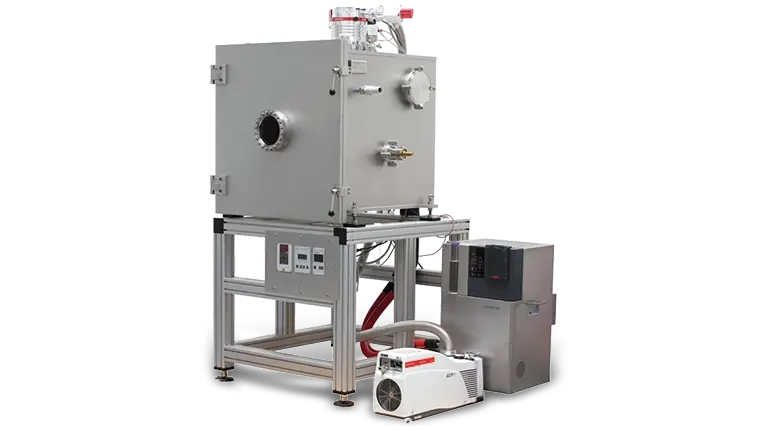
  • Compact thermal vacuum chambers (TVAC)

    Standardized thermal vacuum chamber systems for space-related component and subsystem testing.

    Modular designs allow adaptation to required pressure ranges, optional thermal conditioning, and cleanliness levels, supporting qualification and verification tasks in research and industry.

    con23_972_pvspacesimulation_image_5_exact_767x430_sv
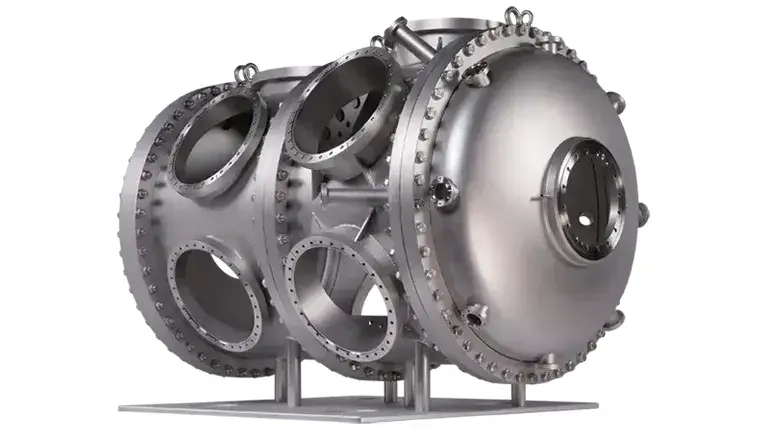
  • Large space simulation chambers

    Custom-designed space simulation chambers for demanding space simulation applications.

    These systems combine ultra-high vacuum performance with application-specific features such as thermal shrouds, large test volumes, and tailored surface finishes for complex qualification and validation campaigns.

    compact_thermal_vacuum_chamber

Designed to support space industry standards

Space-related tests are usually specified against customer standards derived from NASA, ECSS, and ISO 14644 requirements.

Pfeiffer designs vacuum systems and chambers so that the pressure levels, temperature ranges, and cleanliness conditions defined in these test specifications can be set, controlled, and documented reliably. This covers, for example, thermal vacuum and material-screening tests, as well as operation in cleanroom environments.

Where propulsion test setups involve flammable gases or ignition risks, vacuum systems can also be provided in ATEX-rated configurations to meet the necessary safety requirements.
con23_972_pvspacesimulation_image_6_v3_exact_767x767_sv

Customer success stories

Pfeiffer solutions are used in leading research institutes and propulsion facilities where reproducible vacuum conditions are essential for space-related testing.
con23_972_pvspacesimulation_image_exact_7_767x430_sv

CHEOPS Space Telescope (ESA)

University of Bern

To qualify optical assemblies for the CHEOPS mission, the University of Bern operates a 5.5-ton thermal vacuum chamber engineered by Pfeiffer Vacuum+Fab Solutions. It provides stable high vacuum conditions and a temperature-controlled thermal shroud for deep-cold operation down to -90 °C and bake-out up to 160 °C.

The system enables calibration and functional testing of CHEOPS flight hardware under mission-relevant vacuum and thermal conditions.

Download our success story
con23_972_pvspacesimulation_image_8_exact_767x430_sv

VLT and ELT Instrumentation

European Southern Observatory (ESO)

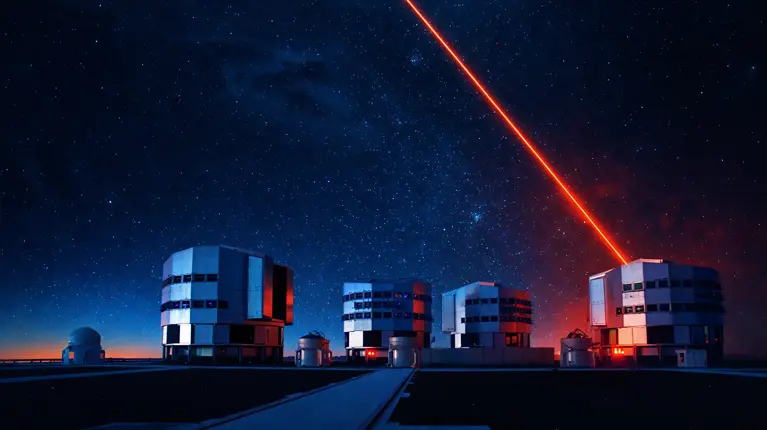
ESO relies on ATH turbomolecular vacuum pumps from Pfeiffer for infrared instruments on the Very Large Telescope. ATH turbopumps have operated for more than a decade without service interruption, and ESO has qualified them for future use at both VLT and the Extremely Large Telescope (ELT). These pumps provide stable high vacuum levels essential for cooling and operating high-sensitivity detector systems.

Download our success story
thumb_nail_space_research_jlu

The marketing-cookies have to be accepted to watch this video.

Allow all cookies

Plasma and ion-beam research

Justus Liebig University (JLU)

JLU uses solutions from Pfeiffer for experiments in plasma physics and ion-beam research.

Stable vacuum conditions support studies on beam-plasma interaction, space-plasma modelling, and fundamental processes relevant to electric propulsion and space environments.
con23_972_pvspacesimulation_image_9_v6_exact_767x430_sv

Chemical propulsion hot-fire testing

Nammo Raufoss propulsion facility

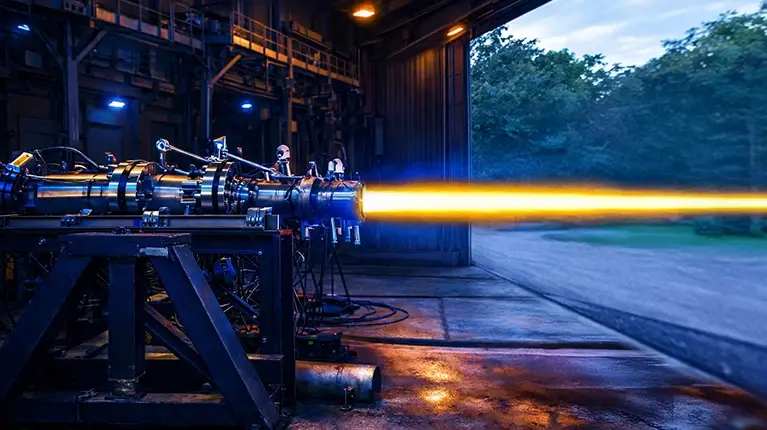
For Nammo’s engine hot-fire facility, Pfeiffer provided a vacuum booster pump unit built from vacuum boosters and dry screw pumps. The system maintains defined back pressure during ignition and abrupt gas load changes, validated through large-orifice step-load testing. It is used in a facility that has conducted more than 1,000 hot-fire tests.

Learn more
Vacuum chamber for the Institute of Plasma Physics and Laser Microfusion (Warsaw)

Institute of Plasma Physics and Laser Microfusion (IFPiLM), Warsaw

Space simulation chamber – IFPiLM Warsaw

For IFPiLM’s space-simulation research facility, Pfeiffer Vacuum+Fab Solutions supplied the vacuum chamber, the associated pump system, and a temperature control system integrated into the thermal vacuum setup.

The system was engineered to meet the institute’s specific boundary conditions and thermal requirements and was developed in close technical collaboration to support plasma-physics and space-technology experiments.

FAQ

How does a thermal vacuum chamber work?

In a thermal vacuum chamber (TVAC), vacuum conditions and defined temperature environments are created to simulate space.

Heat transfer occurs without convection, so temperature is controlled through external heating or cooling concepts such as thermal shrouds. This allows components to be tested for stability and performance under space-relevant pressure and temperature conditions.

How does an ion thruster work?

Ion thrusters ionize a propellant gas such as xenon and accelerate the ions using electric or magnetic fields. The resulting ion beam produces a low but continuous thrust, enabling efficient long-duration propulsion for satellite positioning and deep-space missions.

How does propulsion work in space?

Space propulsion is based on Newton’s third law:expelling mass in one direction generates movement in the opposite direction.

Chemical engines expel hot exhaust gases, while electric propulsion accelerates charged particles. Even without air, the expelled mass provides the reaction force that generates spacecraft motion.

What pressure levels are required for space simulation?

Pressure requirements depend on the application. Many thermal vacuum and material tests operate in the medium vacuum range, while electric propulsion tests often require ultra-high vacuum (UHV) to prevent ion beam distortion and unwanted interactions between propellant particles and the facility.

What materials are suitable for vacuum in space testing?

Materials used in space vacuum testing must exhibit low outgassing, stable mechanical behavior under thermal cycling, and clean, vacuum-compatible surfaces.

Stainless steel is the standard material for vacuum chambers and internal components, as it has inherently low outgassing. Stainless steel surfaces of chambers and components are commonly glass-bead blasted, ground, milled or electropolished. Proper cleaning and leak-tight assembly are essential, and thermal bake-out is often applied to further reduce surface-related gas loads.

Elastomer seals represent the dominant source of residual gases. In addition, materials within the device under test, such as polymers, paints, adhesives, and electrical components, frequently dominate the overall outgassing behavior. These materials are therefore assessed using standardized screening parameters such as Total Mass Loss (TML) and Collected Volatile Condensable Materials (CVCM) as defined in NASA and ECSS material testing standards.

What is vacuum bake-out and why is it necessary?

Vacuum bake out removes adsorbed water and volatile compounds by heating components under vacuum. This reduces contamination risk for optics, detectors, or propulsion hardware and helps achieve stable pressure in subsequent tests.

Bake out is a typical step in material screening and qualification processes.

Why is contamination control so critical in space testing?

Contaminants can migrate and condense on cold surfaces in vacuum, affecting optical coatings, detector performance, or thermal-control surfaces.

Clean surfaces, low-outgassing materials, and controlled vacuum conditions ensure test results accurately reflect behavior in space.

What vacuum setup is required for testing ion thrusters?

Ion-thruster testing typically requires vacuum levels from the 10-7 hPa (mbar) range up to several 10-5 hPa (mbar), depending on propellant flow and thruster type.

Vacuum systems must provide high pumping speed to remove xenon or krypton exhaust and maintain stable background pressure. Residual gas analysis can be used to monitor gas composition during thruster operation.

How does Pfeiffer support customized space simulation setups?

Every test requirement is unique. Pfeiffer designs and builds custom thermal vacuum chambers and integrated vacuum pump units tailored to specific mission profiles.

Whether the goal is ion-thruster plume analysis, material outgassing studies, or telescope mirror coating, our engineers provide end-to-end support – from system design and calculation to installation, calibration, and service.

Contact our experts

Why choose Pfeiffer for space research applications?

Pfeiffer combines more than 130 years of vacuum engineering experience with deep application knowledge in aerospace and research environments. From compact university test rigs to full-scale propulsion facilities, we deliver complete systems – vacuum chambers, pumps, gauges, and analysis tools – that ensure stable, contamination-free, and repeatable test conditions.

Our global service network and close collaboration with research institutes make Pfeiffer a trusted partner for reproducing the conditions of space on Earth.

What is the difference between electric rockets and chemical rockets?

Electric rockets are propulsion systems that use electrical power to ionize and accelerate propellant gases such as xenon. They produce low but continuous thrust and operate in high or ultra-high vacuum conditions

Chemical rockets generate thrust by burning propellants, producing hot exhaust gases and high mass flow. They require vacuum systems that can handle large gas loads and rapid transients during ignition.

Why choose Pfeiffer for space research applications?

Pfeiffer combines more than 130 years of vacuum engineering experience with deep application knowledge in aerospace and research environments. From compact university test rigs to full-scale propulsion facilities, we deliver complete systems – vacuum chambers, pumps, gauges, and analysis tools – that ensure stable, contamination-free, and repeatable test conditions.

Our global service network and close collaboration with research institutes make Pfeiffer a trusted partner for reproducing the conditions of space on Earth.